Overview
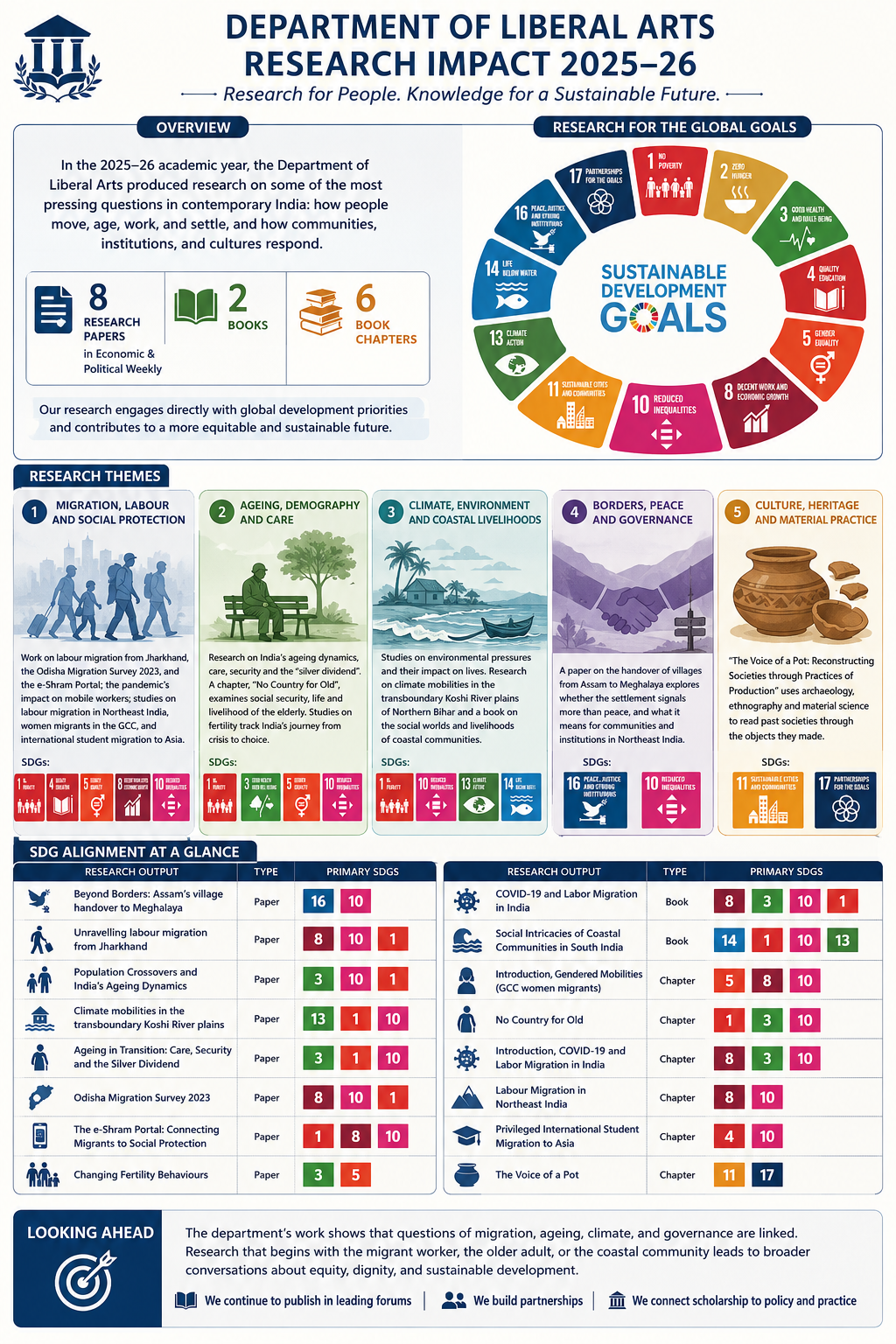
In the 2025-26 academic year, the Department of Liberal Arts produced research on some of the most pressing questions in contemporary India: how people move, age, work, and settle, and how communities, institutions, and cultures respond. The work includes eight research papers in Economic & Political Weekly, two books, and six book chapters, and it engages directly with global development priorities. Each theme below is mapped to the UN Sustainable Development Goals (SDGs).
Research Themes
1. Migration, Labor, and Social Protection
Migration is the department's strongest research area. Faculty work examines labor migration from Jharkhand, findings from the Odisha Migration Survey 2023, and the e-Shram Portal as a route to social protection for migrant workers. The book COVID-19 and Labor Migration in India: Evidence from the Pandemic documents how the pandemic affected mobile workers. Chapters on labor migration in Northeast India and on the intersectional experiences of women migrants in the Gulf Cooperation Council countries extend this work across regions and gender. A chapter on international student migration to Asia looks at how foreign students are included and integrated in Indian higher education.
SDGs: SDG 1 (No Poverty), SDG 4 (Quality Education), SDG 5 (Gender Equality), SDG 8 (Decent Work and Economic Growth), SDG 10 (Reduced Inequalities)
2. Aging, Demography and Care
Research on population change asks what an ageing India will need. Papers address India's ageing dynamics and the care, security, and "silver dividend" of older populations. A chapter titled "No Country for Old" looks at the social security, life, and livelihood of the elderly. The department also studies fertility, tracing how India's fertility journey has moved from crisis to choice.
SDGs: SDG 1 (No Poverty), SDG 3 (Good Health and Well-being), SDG 5 (Gender Equality), SDG 10 (Reduced Inequalities)
3. Climate, Environment, and Coastal Livelihoods
Faculty study how environmental pressures reshape lives. A paper on climate mobilities in the transboundary Koshi River plains of Northern Bihar looks at displacement and mobility in a flood-prone region. The book Social Intricacies of Coastal Communities in South India examines the social worlds and livelihoods of coastal populations.
SDGs: SDG 1 (No Poverty), SDG 10 (Reduced Inequalities), SDG 13 (Climate Action), SDG 14 (Life Below Water)
4. Borders, Peace and Governance
A paper on the handover of villages from Assam to Meghalaya asks whether the settlement signals more than peace. It examines how boundary disputes are resolved and what that means for local communities and institutions in Northeast India.
SDGs: SDG 16 (Peace, Justice and Strong Institutions), SDG 10 (Reduced Inequalities)
5. Culture, Heritage and Material Practice
A chapter, "The Voice of a Pot: Reconstructing Societies through Practices of Production," appears in a Routledge volume on South Asian ceramics, produced in association with TNSDA and IITGN. It uses archaeology, ethnography, and material science to read past societies through the objects they made.
SDGs: SDG 11 (Sustainable Cities and Communities, especially cultural heritage), SDG 17 (Partnerships for the Goals)
Looking Ahead
The department's work shows that questions of migration, aging, climate, and governance are linked. Research that begins with the migrant worker, the older adult, or the coastal community leads to broader conversations about equity, dignity, and sustainable development. The department continues to publish in leading forums and to build partnerships that connect scholarship to policy and practice.